

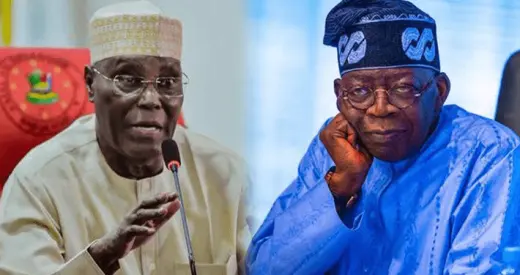
Former Vice President and African Democratic Congress (ADC) presidential candidate, Atiku Abubakar, has challenged President Bola Ahmed Tinubu’s administration to provide a detailed account of the ₦11.2 trillion recorded by the Nigerian National Petroleum Company Limited (NNPCL) as receivables from the Federation.
Atiku also demanded disclosure of contracts, payments and performance records relating to the protection of Nigeria’s oil and gas infrastructure, while questioning whether companies and individuals benefiting from government contracts are providing financial or material support for Tinubu’s 2027 re-election campaign.
The former vice president made the demands in a statement issued on Sunday by Phrank Shaibu, Director of Strategic Communication of the ADC Presidential Campaign Council.
Atiku said Nigerians deserved to know how much of the ₦11.2 trillion was associated with pipeline surveillance and the protection of oil and gas assets, who received the payments, what services were provided and what results were achieved.
He questioned the lack of detailed information in the published figures, asking what was paid, who was paid, for what work and where the results were.
NNPCL’s ₦11.2 Trillion Receivables
The controversy followed the publication of NNPCL’s 2025 audited financial statements, which showed approximately ₦11.2 trillion in “other receivables from the Federation.”
The accounts indicate that the receivables relate to advances to the Federation and costs incurred in protecting the country’s oil and gas assets under an approved framework between the Federal Government and NNPCL.
NNPCL’s 2024 accounts had recorded about ₦17.5 trillion in various claims on the Federation, including energy-security costs and other receivables.
However, the ₦11.2 trillion figure should not be interpreted as ₦11.2 trillion in fresh cash paid to pipeline-security contractors in 2025.
The figure represents receivables recorded by NNPCL against the Federation and covers different categories of advances and costs.
Atiku nevertheless argued that the accounts did not provide Nigerians with sufficient information to determine how much was specifically spent on pipeline surveillance and asset protection.
Atiku Questions Pipeline Security Spending
The ADC presidential candidate compared the NNPCL figure with the Federal Government’s allocation to the Ministry of Defence, which he put at approximately ₦3.1 trillion in the 2025 budget.
Atiku argued that the comparison raised questions about the scale and transparency of expenditure associated with protecting the country’s oil infrastructure while Nigerians continued to face insecurity in communities, on highways and around schools.
He called for the publication of relevant contracts, payment records, procurement documents and evidence of the results achieved through pipeline-security arrangements.
NNPCL has previously defended its integrated security programme, saying it contributed to improved crude oil production by combining intelligence gathering, security operations, regulatory oversight and community-based surveillance.
Atiku Links Contracts to 2027 Campaign Financing
Atiku also turned his attention to the financing of President Tinubu’s 2027 re-election campaign.
He questioned whether companies and individuals benefiting from major government contracts had provided financial or material support to Tinubu’s campaign.
In particular, Atiku raised questions about companies involved in pipeline security and the Lagos-Calabar Coastal Highway project, demanding that the government disclose the relevant procurement processes, competing bids, evaluations and contract documents.
He also called for disclosure of any contributions, vehicles or other forms of support allegedly provided by government contractors to the President’s re-election effort.
The allegations concerning campaign financing are claims made by Atiku and his campaign team and should not be treated as established findings of wrongdoing.
Atiku: Nigerians Deserve Full Accountability
Atiku said a government asking Nigerians to endure economic hardship must also be prepared to account for public funds and contracts.
He criticised the Tinubu administration over insecurity, the cost of living and economic hardship, arguing that Nigerians should not be expected to make sacrifices without corresponding transparency from government.
He maintained that the 2027 election would provide Nigerians with an opportunity to decide whether the current administration should continue in office.
The demand comes as political activities intensify ahead of the 2027 general elections, with the ADC candidate increasingly positioning transparency, accountability, economic hardship and security as major issues in his challenge to the Tinubu administration.
0 Comments
No comments yet. Be the first to share your thoughts.
Leave a Comment