

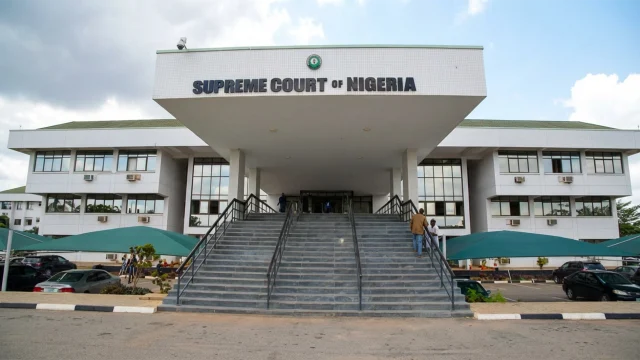
ABUJA — The Supreme Court has upheld an appeal filed by the Independent National Electoral Commission (INEC) against a Court of Appeal judgment that voided parts of the Electoral Act 2026 relating to political party membership registers and the nomination of candidates.
A seven-member panel of the apex court, led by Justice Adamu Jauro, set aside the Court of Appeal’s July 16 judgment and restored the decision of the Federal High Court, which had earlier dismissed the challenge brought by the Zenith Labour Party (ZLP).
The Supreme Court specifically validated Sections 77(5), 77(6), 77(7) and 84(2) of the Electoral Act 2026, holding that the provisions are not inconsistent with the 1999 Constitution, as amended.
Sections 77(5) to (7) deal with the submission and use of political parties’ membership registers for primaries, congresses and conventions. Section 84(2) provides for direct primaries or consensus as methods for political parties to nominate candidates for elective positions.
The legal dispute began after the ZLP challenged the provisions at the Federal High Court in Abuja, arguing that they amounted to unconstitutional interference in the internal affairs of political parties and conflicted with constitutional provisions governing political parties.
Justice Mohammed Umar of the Federal High Court dismissed the suit on May 5, 2026. The ZLP subsequently appealed, leading to the Court of Appeal’s July 16 judgment, which voided parts of the disputed provisions.
Dissatisfied with that decision, INEC approached the Supreme Court, asking the apex court to reverse the Court of Appeal’s ruling.
In its Thursday judgment, the Supreme Court reinstated the Federal High Court’s decision and awarded ₦2 million in costs against the ZLP.
The ruling comes ahead of the 2027 general elections and settles the immediate legal dispute over the validity of the affected provisions of the Electoral Act 2026.
The Supreme Court also dismissed a separate appeal filed by the Social Democratic Party (SDP) and struck out the Youth Party’s appeal after upholding INEC’s preliminary objection that the case was incompetent because it was filed one day out of time.





0 Comments
No comments yet. Be the first to share your thoughts.
Leave a Comment