
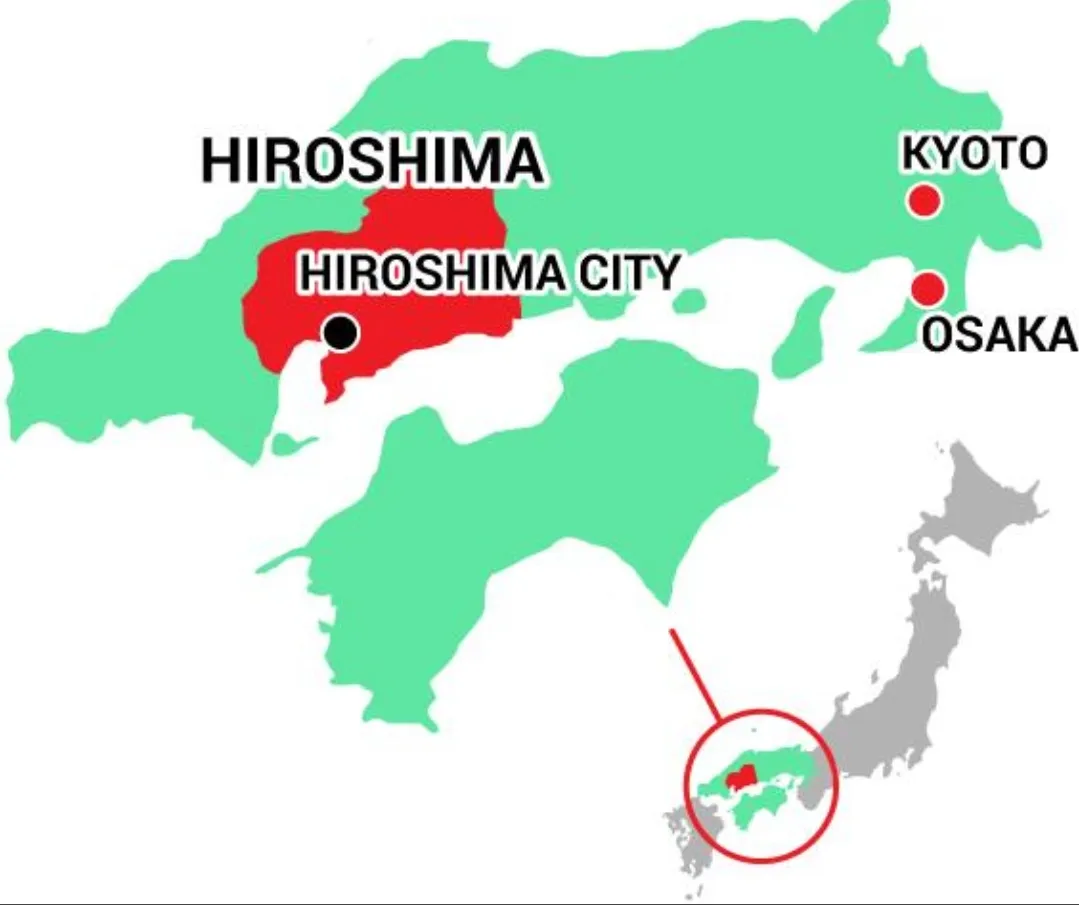
At approximately 8:15 a.m. on August 6, 1945, the United States dropped an atomic bomb known as “Little Boy” on Hiroshima, Japan. It was the first time a nuclear weapon was used in warfare, marking a turning point in world history.
At the time, Hiroshima was a functioning city with a population of roughly 350,000 people, including civilians, military personnel, workers and others who had travelled into the city. It was also an important military, industrial and communications centre for Japan.
Why was Hiroshima targeted?
The bombing took place during the final months of World War II.
The United States had developed the atomic bomb through the highly secret Manhattan Project. In July 1945, the United States successfully tested the world's first nuclear device at the Trinity test site in New Mexico.
As the war approached its end, American leaders sought a way to force Japan to surrender. Hiroshima was among the cities considered because of its military significance and because much of the city had not been heavily damaged by conventional bombing. This would allow the effects of the new weapon to be more clearly assessed.
Hiroshima was ultimately selected as the primary target for the August 6 mission.
The mission
In the early hours of August 6, the American B-29 bomber Enola Gay, commanded by Colonel Paul Tibbets, took off from Tinian Island in the Mariana Islands.
On board was Little Boy, a uranium-235 atomic bomb.
The aircraft approached Hiroshima on a clear morning. At approximately 8:15 a.m. Hiroshima time, bombardier Thomas Ferebee released the bomb from an altitude of about 31,000 feet (9,467 metres).
Little Boy did not explode when it reached the ground.
Instead, it fell for approximately 43 seconds before detonating about 600 metres above the city, near what is now central Hiroshima.
The explosion
The explosion was unlike anything previously experienced in warfare.
Little Boy produced an explosive force equivalent to approximately 15,000 tons of TNT.
Almost instantaneously, an enormous fireball formed over Hiroshima. According to Hiroshima authorities, temperatures at the centre of the fireball exceeded one million degrees Celsius, while temperatures at ground level near the hypocentre reached approximately 3,000–4,000°C.
The destruction came primarily through three devastating effects:
1. Heat
The bomb released an enormous amount of thermal radiation.
People close to the hypocentre suffered catastrophic and often fatal burns. Wooden buildings caught fire almost immediately, while people several kilometres away also suffered severe burns to exposed skin.
2. Blast
The explosion generated an immense pressure wave that tore through the city.
Buildings collapsed, windows shattered and debris became deadly projectiles. Structures within roughly two kilometres of the hypocentre were extensively destroyed, while fires spread across large parts of Hiroshima.
3. Radiation
The atomic bomb also released intense nuclear radiation, something conventional explosives could not produce.
Some people who survived the initial explosion, burns and injuries later became seriously ill from radiation exposure. They suffered symptoms including vomiting, bleeding, infections and other complications.
Consequently, the deaths continued long after the explosion itself.
The human cost
The exact number of people killed in Hiroshima cannot be determined with absolute precision.
Hiroshima authorities estimate that approximately 140,000 people, plus or minus 10,000, had died as a result of the bombing by the end of 1945.
Some victims died almost instantly. Others died in the days, weeks and months that followed from severe burns, injuries, fires and radiation exposure.
Although Hiroshima contained military personnel, the victims were overwhelmingly civilians. People of different nationalities were also in the city, including Koreans, Taiwanese, Chinese and Japanese-Americans.
Hiroshima after the bomb
The city was devastated.
The explosion destroyed or severely damaged a huge proportion of Hiroshima's buildings. Fires swept through neighbourhoods as survivors searched desperately for relatives and sought medical assistance.
The destruction of hospitals and other medical facilities made the situation even worse. Many doctors and nurses were killed or injured, leaving thousands of wounded people without adequate medical care.
Within moments, Hiroshima had been transformed from a functioning city into a landscape of destruction and ruins.
One of the structures that partially survived was the Hiroshima Prefectural Industrial Promotion Hall. Its skeletal remains became known as the Atomic Bomb Dome, which today stands as one of the world's most recognizable symbols of the nuclear age.
What happened three days later?
The Hiroshima bombing did not immediately result in Japan's surrender.
On August 9, 1945, the United States dropped a second atomic bomb, known as “Fat Man,” on Nagasaki.
The bombings of Hiroshima and Nagasaki remain the only instances in which nuclear weapons have been used in warfare.
The Soviet Union also entered the war against Japan in August 1945.
On August 15, 1945, Japan announced its acceptance of the Allied surrender terms, effectively bringing World War II to an end.
Why Hiroshima remains important today
The significance of Hiroshima extends far beyond World War II.
The bombing demonstrated, for the first time, the enormous destructive power of a nuclear weapon and its ability to devastate a major urban area within moments.
It also exposed humanity to the long-term consequences of nuclear radiation.
Survivors of the atomic bombings became known as hibakusha. Many endured lifelong health problems and social difficulties as a result of their experiences.
Hiroshima subsequently became an international symbol of peace, remembrance and the campaign for nuclear disarmament.
Today, the Hiroshima Peace Memorial and Atomic Bomb Dome preserve the memory of those who died and the destruction suffered by the city.
Why 8:15 a.m. is remembered
The time 8:15 a.m. has become permanently associated with Hiroshima.
Every year on August 6, Hiroshima holds its Peace Memorial Ceremony. At 8:15 a.m., a moment of silence is observed in remembrance of those who died and in reflection on the consequences of nuclear warfare.
The ceremony also renews Hiroshima's call for a world free of nuclear weapons.
August 6, 1945 — a moment that changed history
At 8:15 a.m., an atomic bomb exploded approximately 600 metres above Hiroshima.
In a matter of seconds, heat, blast and radiation devastated the city and killed or injured enormous numbers of people.
By the end of 1945, approximately 140,000 people were estimated to have died as a consequence of the bombing.
Three days later, Nagasaki was struck by a second atomic bomb.
Japan surrendered days afterward, ending World War II.
But Hiroshima's story did not end with the war. Its destruction, the experiences of the hibakusha, and the continuing threat posed by nuclear weapons have made August 6 one of the most significant dates in modern history.





0 Comments
No comments yet. Be the first to share your thoughts.
Leave a Comment