
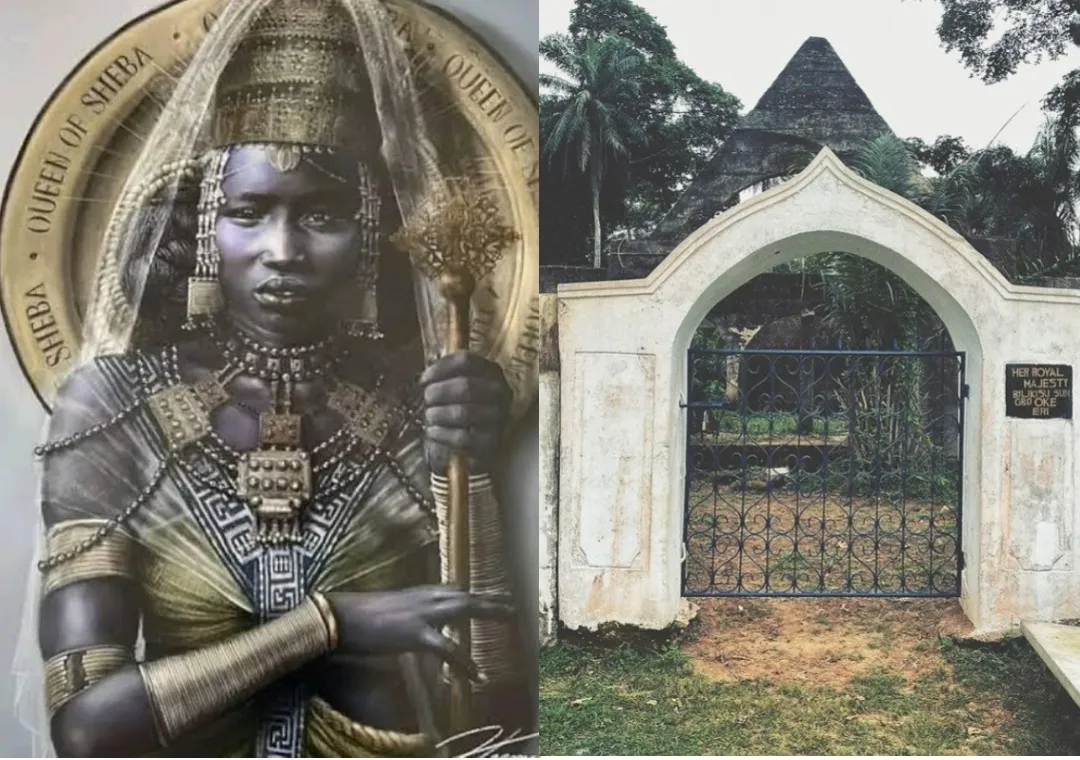
Who was Bilikisu Sungbo? What was her connection with King Solomon? Who was Aleyo, the husband she left behind in Ijebuland? And what explains the extraordinary mysteries surrounding her burial site at Oke-Eri, Ogun State?
Deep within the historical and cultural heritage of Ijebuland, southwestern Nigeria, lies one of the most fascinating stories in Yoruba oral tradition: the story of Bilikisu Alaga Wura, popularly known as Bilikisu Sungbo.
Celebrated as a remarkably wealthy, powerful and mysterious woman, Bilikisu Sungbo occupies a special place in Ijebu history. Local tradition identifies her with the legendary Queen of Sheba, known as Bilqis in Islamic tradition and Makeda in Ethiopian accounts.
Her story is filled with accounts of extraordinary wealth, royalty, a journey to meet King Solomon, a mysterious husband, unusual physical characteristics and a burial site surrounded by fascinating traditional beliefs.
Beyond the mystery surrounding her identity, the stories preserved by the people of Oke-Eri make her one of the most intriguing figures in Yoruba cultural history.

1\. WHO WAS BILIKISU ALAGA WURA?
Bilikisu Sungbo is remembered in Ijebu oral tradition as an exceptionally wealthy and influential woman whose reputation extended beyond the ordinary boundaries of her time.
Her title, Alaga Wura, is popularly interpreted as the owner or possessor of a golden throne, reflecting the extraordinary wealth, royalty and prestige associated with her name.
According to traditional accounts, she was a woman of immense resources, power and influence.
Her story is closely connected to the Queen of Sheba, the celebrated monarch who travelled to Jerusalem to meet King Solomon after hearing about his extraordinary wisdom and wealth.
The biblical account in 1 Kings 10 describes how the Queen of Sheba arrived with a great caravan carrying gold, spices and precious stones.
The Qur'an also recounts the encounter between Prophet Sulayman (Solomon) and the Queen of Sheba in Surah An-Naml, chapters 27:20–44.
While Islamic tradition identifies the queen as Bilqis, Yoruba oral tradition connects her with Bilikisu Sungbo of Ijebuland.
Although historians have not established that they were the same historical individual, the connection remains an important part of the cultural identity surrounding Bilikisu Sungbo.
2\. ALEYO: THE HUSBAND SHE LEFT BEHIND IN OKE-ERI
One of the lesser-known but fascinating aspects of Bilikisu Sungbo's story is her marriage to a man known as Aleyo.
According to the traditional account preserved in Oke-Eri, Aleyo was Bilikisu Sungbo's husband before she embarked on her journey to meet King Solomon.
The story takes a mysterious turn when Bilikisu departed for her legendary journey, leaving her husband behind in Ijebuland.
During her absence, Aleyo was said to have transformed into a river within the Ijebuland metropolis.
This extraordinary account has remained part of the oral narratives surrounding Bilikisu Sungbo and her connection with the geographical and cultural history of Ijebuland.
The story raises an interesting question: What is the identity of the river associated with Aleyo, and what historical or traditional explanation lies behind this unusual narrative?
It is one of the lesser-explored dimensions of the Bilikisu Sungbo legend that deserves further documentation.
3\. THE MYSTERIOUS DESCRIPTION OF HER PHYSICAL APPEARANCE
Perhaps one of the most unusual aspects of the Bilikisu Sungbo story concerns descriptions of her physical appearance.
In traditional accounts, she is described as an extraordinary being, possessing characteristics that distinguish her from an ordinary human.
She is portrayed as exceptionally tall, dark in complexion and having legs resembling those of a horse.
Some traditional narratives go further to describe her as half-human and half-animal.
This unusual description has contributed significantly to the mysterious image surrounding her personality, particularly the stories about her burial site.
The horse-like appearance of her legs is also connected to the account of what foreign visitors encountered during the reported examination of her grave in 2018.
These descriptions form part of the traditional narratives through which generations have preserved her story.
4\. THE EXTRAORDINARY MYSTERY SURROUNDING HER GRAVEYARD

Perhaps the most captivating part of the Bilikisu Sungbo story is the mystery surrounding her graveyard at Oke-Eri.
The burial site is associated with several unusual characteristics that continue to attract the attention of visitors, researchers and people interested in Yoruba history.
According to the traditional accounts maintained by the community, leaves, dust and other forms of dirt do not accumulate on the surface of her grave.
The graveyard is described as consistently neat, with fine, powdery sand covering its surface.
Another fascinating detail is that the surface of the grave often appears as though somebody has just swept it with a broom, even when nobody has physically swept the area.
This unusual observation has become one of the most frequently discussed mysteries surrounding the burial site.
THE MYSTERIOUS COBWEB ROOF
Another fascinating account concerns the original covering of the grave.
According to local tradition, cobwebs initially formed a natural roof over the burial area.
The cobweb covering served as protection against falling leaves, dust and other materials that could accumulate on the surface of the grave.
Over time, an iron roofing structure was constructed over the burial enclosure, replacing the original cobweb covering.
This remains one of the interesting details in the traditional history of the shrine.

5\. WHY ARE WOMEN NOT ALLOWED INTO THE INNER BURIAL ENCLOSURE?
One of the most discussed customs surrounding Bilikisu Sungbo's shrine is the restriction on women's access to the inner burial enclosure.
According to the traditional rules maintained by the shrine custodians, women are not permitted to enter the designated inner section of the burial site.
The restriction is regarded as an important part of the customs and traditions governing the sacred location.
Stories surrounding the shrine also contain accounts of visitors who disregarded its rules and subsequently encountered tragic circumstances.
THE STORY OF A WHITE MAN AND HIS WIFE
One of the stories associated with the shrine concerns a white man and his wife who visited Oke-Eri on an excursion during the late 19th century.
According to the account, the couple visited the sacred location and began their journey back after the excursion.
However, around Eredo Junction, they became involved in a fatal road accident, and their vehicle caught fire, leaving them burnt beyond recognition.
The story has since become part of the mysterious narratives surrounding the shrine.
THE WHITE MAN WHO VISITED WITH HIS DOG IN 1999
Another intriguing story concerns a white man who visited the shrine with his dog.
Upon arriving at the sacred premises, the dog was not permitted to enter the restricted area.
The visitor subsequently left the location with his dog.
The traditional account states that while returning from the excursion, the man and his dog became involved in a fatal accident and both lost their lives.
These stories have continued to circulate within the narratives surrounding the shrine, reinforcing the importance attached to observing its traditional rules.
6\. WHY ARE SHOES AND SLIPPERS PROHIBITED?
Visitors entering Bilikisu Sungbo's graveyard are required to remove their footwear.
Shoes, slippers and other forms of footwear are not permitted within the designated burial enclosure.
The practice is regarded as an expression of respect for the sacredness of the location and the traditional customs established by its custodians.
Consequently, visitors must enter the designated area barefoot, observing the rules governing the shrine.
For many people visiting Oke-Eri for the first time, this is one of the most striking aspects of the experience.
7\. THE 2018 VISIT BY SUDANESE RESEARCHERS: THE MYSTERY OF THE UNDECAYED BODY
Perhaps the most extraordinary account surrounding Bilikisu Sungbo concerns a visit by a group of white researchers from Sudan in 2018.
According to the account associated with the shrine, the visitors arrived with specialised machines and scientific equipment to examine the burial site and investigate whether the body believed to be buried there had undergone decomposition.
They reportedly positioned their equipment around the grave and commenced their examination.
The story maintains that the images displayed on their machines revealed the presence of a body that had not decayed.
Even more fascinating was the description of what appeared on the equipment's screen.
The image showed the position of the head, which was described as glittering like gold, while the legs retained the appearance of a horse.
The researchers were said to have spent several hours attempting to capture photographs of the images displayed by their machines.
However, despite repeated efforts, they could not obtain the pictures.
The account has become one of the most extraordinary stories associated with the shrine, particularly because it connects the traditional description of Bilikisu Sungbo's physical appearance with the mystery surrounding her burial.
The identities of the researchers, the institution they represented, the equipment used and the examination results remain important details requiring independent documentation.
Nevertheless, the story continues to generate curiosity about what lies beneath the historic burial site.
8). SUNGBO'S EREDO: THE ANCIENT MONUMENT CONNECTED TO HER LEGACY

The Estate That Shares a Boundary With the Monumental Sungbo Eredo
Beyond the mysterious accounts surrounding her burial, Bilikisu Sungbo is closely connected with one of Africa's most remarkable ancient engineering achievements: Sungbo's Eredo.
Sungbo's Eredo is an enormous system of ancient defensive ditches and embankments surrounding parts of the historic Ijebu territory.
The earthwork stretches approximately 150–160 kilometres and remains one of the most impressive ancient monuments in West Africa.

Local tradition attributes the construction of this extraordinary structure to Bilikisu Sungbo, with accounts suggesting that it was built in her honour.
However, archaeological research indicates a more complex history, with continuing scholarly discussions about its precise construction date, purpose and relationship with the development of the ancient Ijebu Kingdom.
Regardless of the final historical conclusions, Sungbo's Eredo provides remarkable evidence of the engineering, organisational and political capabilities of ancient African societies.
It also demonstrates why the history of Ijebuland deserves greater attention in Nigeria's historical and cultural discussions.
WHY BILIKISU SUNGBO DESERVES INTERNATIONAL ATTENTION

The story of Bilikisu Sungbo goes beyond supernatural accounts and religious narratives.
It offers an opportunity to explore the historical contributions of women, the development of ancient African civilisation and the importance of preserving indigenous knowledge.
Her connection with the Queen of Sheba also presents an interesting subject for comparative historical and religious research.
Oke-Eri has the potential to become a more prominent destination for cultural tourism, historical research and heritage education.
The Ogun State Government, historians, archaeologists, cultural institutions and traditional authorities should work together to document the stories surrounding Bilikisu Sungbo and preserve the historical sites associated with her legacy.
The preservation of Sungbo's Eredo and the Bilikisu Sungbo shrine should also be considered an important part of protecting Nigeria's cultural heritage.
PRESS DISCUSSION: WHAT DO YOU THINK?
The story of Bilikisu Alaga Wura is filled with extraordinary accounts that have survived through generations of Ijebu oral tradition.
From her marriage to Aleyo and his mysterious transformation into a river, to descriptions of her unusual physical appearance, the extraordinary cleanliness of her graveyard, the restrictions governing access to her shrine and the 2018 visit by foreign researchers, her story continues to generate curiosity.
But beyond the mystery, several questions deserve public attention:
1\. Was Bilikisu Sungbo truly the Queen of Sheba who travelled to meet King Solomon?
2\. Who was Aleyo, and which river in Ijebuland is connected to the story of his transformation?
3\. What explains the traditional description of Bilikisu Sungbo as a woman with horse-like legs?
4\. Why does her graveyard reportedly remain free of leaves and dirt, with its surface appearing freshly swept?
5\. What happened during the 2018 visit by the Sudanese researchers, and can the scientific examination be independently documented?
6\. Why are women prohibited from entering the inner burial enclosure, and what is the origin of this tradition?
7\. What can the Ogun State Government do to preserve the shrine and Sungbo's Eredo as important historical and cultural tourism destinations?
OUR POSITION
Nigeria is blessed with extraordinary historical and cultural heritage, but many of its fascinating stories remain confined to local communities and oral traditions.
Bilikisu Sungbo's story deserves serious attention, proper documentation and further historical investigation.
Whether she was truly the Queen of Sheba remains an open historical question. However, her association with ancient Ijebuland, the remarkable Sungbo's Eredo and the enduring traditions of Oke-Eri make her legacy worthy of national and international recognition.
We must not dismiss our indigenous history simply because some of its accounts appear mysterious. Equally, we must encourage research that separates established historical evidence from traditional beliefs.
Perhaps the greatest mystery is not just who Bilikisu Sungbo was, but how much of her extraordinary story remains unknown to the world.

PRESS POINT NEWS | PRESS DISCUSSION
History deserves investigation. Tradition deserves documentation. Heritage deserves preservation.


0 Comments
No comments yet. Be the first to share your thoughts.
Leave a Comment