

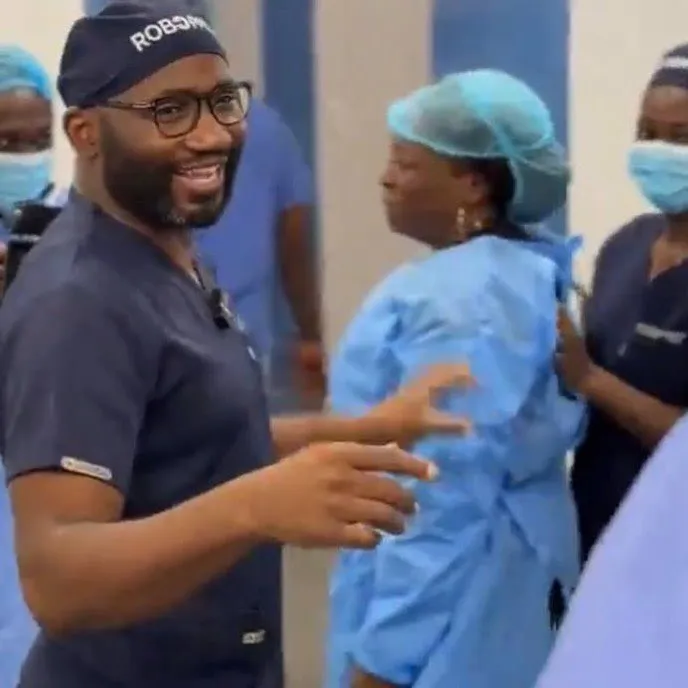
Nigeria has recorded its first tele-robotic surgery, marking a significant milestone in the country’s healthcare and medical technology sector.
The procedure, a robot-assisted right radical nephrectomy to remove a cancerous kidney tumour, was carried out through a collaboration between Redeemer’s Health Village (RHV) and RoboMed Global.
Professor Ekwenna Davis, Co-founder of RoboMed Global and Professor of Urology and Transplantation, performed the surgery remotely from a Toumai robotic surgical console at RHV in Mowe, Ogun State, while the patient was receiving care at Nisa Premier Hospital in Abuja, approximately 500 kilometres away.

The operation lasted about three hours and relied primarily on Starlink satellite internet connectivity, with MTN providing backup connectivity to support uninterrupted communication between the surgeon and the robotic system.
Speaking about the procedure, Davis described the operation as an important demonstration of how emerging technology could improve access to specialised medical expertise in Nigeria.
> “The procedure we did was a telesurgery procedure where we were able to operate on a patient in Abuja, 500 kilometres away,” he said.
Davis said the development was only the beginning of efforts to explore how technology could transform access to specialised healthcare.
> “This is just the beginning. It is a test, a pilot, of how innovation and technology can really help patients,” he added.
According to him, tele-robotic surgery could potentially reduce the need for patients to travel long distances or seek certain specialised procedures abroad. It could also create opportunities for Nigerian medical specialists living outside the country to provide expertise remotely.
However, Davis acknowledged that reliable connectivity remains crucial to the success and safety of remote surgery. He noted that network disruptions and weather conditions could present challenges, making dependable infrastructure, contingency systems and appropriate safeguards essential.

The Chairman of the RHV Board, Dr Kunle Onakoya, also stressed that the surgical robot does not perform procedures independently.
“The robot is still being controlled by a human being, by a very experienced and senior surgeon. It is just that the skills of that surgeon are now being magnified many times over by the robot,” Onakoya explained.
The landmark procedure highlights the growing role of robotics, telecommunications and digital technology in healthcare and could open new possibilities for delivering highly specialised surgical services across geographical boundaries in Nigeria.


0 Comments
No comments yet. Be the first to share your thoughts.
Leave a Comment