

OSOGBO, Osun State — Political commentator James Bamgbose has drawn parallels between President Bola Ahmed Tinubu and Osun State Governor Ademola Adeleke, describing both leaders as political strategists who have demonstrated the ability to build loyal followings, overcome setbacks and sustain their influence across party lines.
In an opinion article titled “In Politics, Recognise an Asiwaju,” Bamgbose argued that Adeleke’s emergence as the coordinator of the PBAT/APC Presidential Campaign Council in Osun State reflects growing recognition of his political influence and electoral strength.
The writer compared Tinubu’s longstanding political influence in Lagos and the South-West with Adeleke’s growing dominance in Osun, arguing that both politicians have built political movements that extend beyond their respective party platforms.
Bamgbose traced Tinubu’s political journey from his election as senator representing Lagos West in 1992 to his emergence as Lagos State governor in 1999 and his re-election in 2003.
He also highlighted Tinubu’s role in the formation of the All Progressives Congress (APC), which defeated the Peoples Democratic Party (PDP) in the 2015 presidential election, as well as his eventual election as president in 2023.
According to the writer, Tinubu’s political experience demonstrates the importance of strategic alliances, organisational structures and the ability to maintain influence beyond elective office.
Turning to Adeleke, Bamgbose recalled the governor’s entry into elective politics following the death of his elder brother, Senator Isiaka Adeleke, in 2017.
He noted that Adeleke won the Osun West senatorial by-election that year before contesting the 2018 governorship election, which was decided in favour of the then-incumbent, Gboyega Oyetola, after a rerun.
The article further highlighted Adeleke’s victory in the 2022 governorship election, when he defeated Oyetola, and his subsequent re-election in the August 15, 2026, poll on the platform of the Accord Party.
According to the figures cited by Bamgbose, Adeleke secured 511,067 votes against the APC candidate’s 444,815, winning by a margin of 66,252 votes and carrying 19 of Osun State’s 30 local government areas.
The writer argued that the results demonstrated Adeleke’s ability to retain electoral support despite changing political platforms and opposition from the ruling party at the federal level.
Bamgbose also contrasted the leadership styles of the two politicians, describing Tinubu as a calculated strategist known for building political structures and Adeleke as a grassroots-oriented leader whose public personality and connection with ordinary voters have become central to his political appeal.
He maintained that, despite their different approaches, both politicians share an ability to cultivate personal followings that can survive changes in party affiliation.
The article also examined Adeleke’s decision to leave the PDP for the Accord Party ahead of the 2026 governorship election, a move the writer attributed to the leadership crisis within the opposition party.
Bamgbose argued that Adeleke’s victory under a different platform reinforced his claim that political loyalty in Osun increasingly centres on the governor rather than party identity alone.
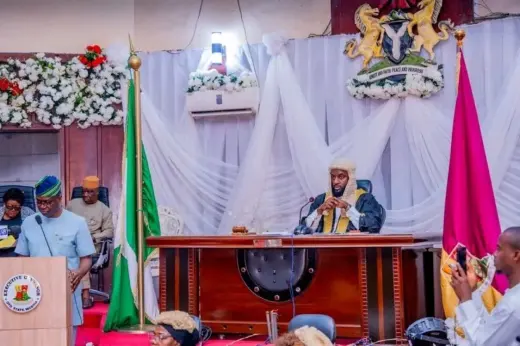
The commentary comes amid the inauguration of a 344-member Osun State chapter of the PBAT/APC Presidential Campaign Council, an event Bamgbose said was attended by prominent APC figures, including Chief Bisi Akande and the party’s National Secretary, Senator Ajibola Basiru.
He interpreted Adeleke’s leadership of the council as an indication that Tinubu’s political camp recognises the governor’s electoral value in Osun State ahead of the 2027 presidential election.
Bamgbose urged APC stakeholders in Osun to prioritise the party’s presidential ambition over internal disagreements, arguing that electoral success would depend on the ability to build broad-based alliances and mobilise voters.
He questioned whether party leaders would be better served by backing a governor who had won successive elections or by continuing to rely on internal political structures that, in his view, had failed to secure victory in recent Osun governorship contests.
“Politics is not sentiment. It is arithmetic,” Bamgbose argued, maintaining that the votes Adeleke secured in the 2026 election should inform the APC’s strategy for the next presidential contest.
He concluded that Osun already had a political figure whose influence could be decisive in the 2027 election, adding that Tinubu’s reported choice to work with Adeleke should encourage other APC stakeholders to reconsider their positions.
Bamgbose, who hails from Igbajo in Boluwaduro Local Government Area of Osun State, said recognising Adeleke’s political strength would be a pragmatic step for those seeking Tinubu’s re-election.




0 Comments
No comments yet. Be the first to share your thoughts.
Leave a Comment